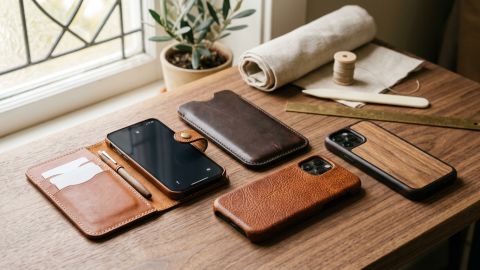
Learn how leather edge finishing is done on genuine leather products. Explore edge sanding, painting, burnishing, and polishing techniques.
A high-quality leather product stands out in the details. Even with precise cuts and tight stitching, raw leather edges wear down over time and lose their appeal. On handmade, vegetable-tanned genuine leather designs, edge finishing directly determines lifespan. Proper edge work prevents moisture and dirt from penetrating internal fibers. In this article, we look at the traditional edge finishing steps used in our workshop.
1. Edge Preparation and Beveling
Cut leather pieces have sharp, right-angle edges. Left untreated, these sharp corners deform quickly from friction. First, leather layers are joined with specialized leather glue. The layers must align perfectly without gaps. Once the glue dries, a trimming knife creates a clean, aligned cut.
An edge beveler is then used on the aligned edges. This tool shaves the sharp top and bottom corners at a precise angle. Rounding the edges allows paint and burnishing fluids to spread evenly. On items held all day, such as phone cases, rounded edges ensure a comfortable grip.
The beveler size must match the leather thickness. A thin card holder edge and a thick belt edge require different bevel angles. An incorrect angle can damage the layer structure. Hand precision is essential at this stage.
2. Progressive Sanding and Smoothing
After beveling, the edge is not yet smooth. Progressive sanding prevents leather fibers from splitting and creates a uniform surface. This mechanical step requires patience.
Sanding starts with low grit sandpaper (around 320 grit) and advances to high grit (1000 grit and above). Each pass flattens the fibers, smoothing the edge. Apply balanced pressure to avoid tearing fibers or generating excess friction heat.
- Coarse Sanding (320-400 Grit): Eliminates height differences between layers.
- Medium Sanding (600-800 Grit): Smooths leather fibers and creates an even surface.
- Fine Sanding (1000-1500 Grit): Flattens fibers completely before polishing and painting.
Thick products built for daily use, like the Hunter Men's Leather Belt, require thorough sanding. Paint or sealant applied to an unsanded edge will peel quickly.
3. Edge Burnishing with Tokanol
Burnishing compacts and shines vegetable-tanned leather fibers using friction heat. Chrome-tanned leather does not respond to burnishing, but natural veg-tan leather yields excellent results.
Water-based gums or specialized agents like Tokanol are applied lightly to the edge. A wooden slicker is rubbed rapidly along the groove. Friction heat binds the fibers, creating a smooth, durable, and naturally dark edge.
This creates a completely natural finish without synthetic layers. Burnishing is repeatable. You apply liquid, slick the edge, sand lightly, and burnish again until reaching desired smoothness.
4. Edge Painting and Layering
Some designs feature burnished edges with a natural wood look. Others require edge paint that matches or contrasts the leather color. Professional leather edge paints are used for this style.
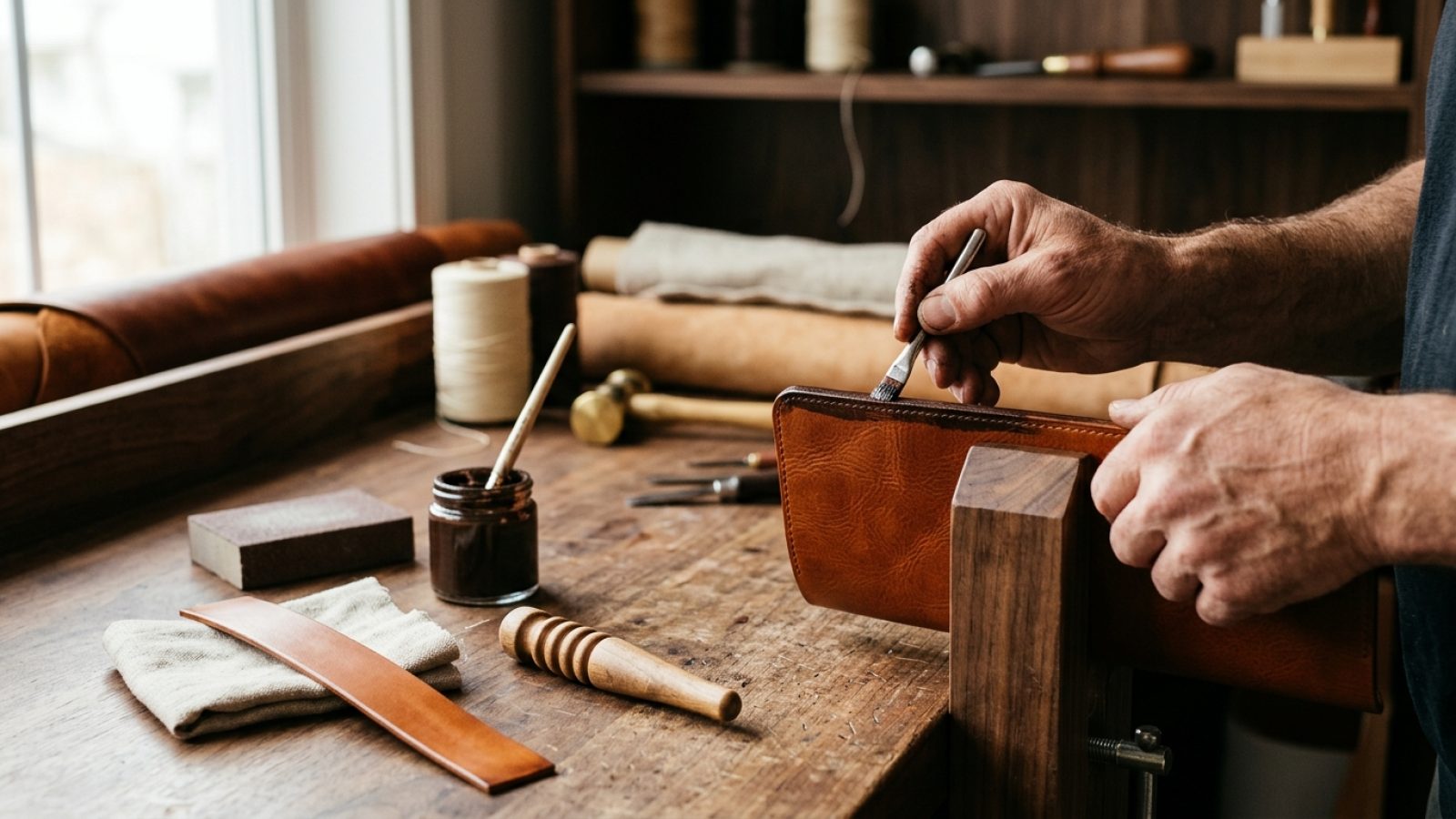
Edge paint is applied with a roller pen or fine brush. The first coat acts as a primer, penetrating into the leather. After drying, light sanding removes bubbles. Second and third coats follow for solid coverage and depth.
Allow paint to dry naturally in ambient air. Heat guns can cause the paint to crack. Quality edge paint stays flexible for years without cracking at flex points.
5. Protective Wax and Edge Sealing
The final step is sealing. Painted or burnished edges need protection against water, dirt, and friction. A final coat of natural beeswax or edge sealant seals the surface.
Beeswax is rubbed onto the edge and buffed rapidly with a cotton cloth or felt wheel. Melting wax penetrates the leather pores, offering water resistance and a clean satin finish.
Careful edge work defines product quality. Handmade leather goods maintain their shape for years thanks to this detailed process.
Frequently Asked Questions
Does leather edge paint peel over time?
Properly sanded, primed, and layered edge paint remains flexible and does not peel. Peeling usually happens on poorly prepared, unsanded surfaces.
Can every leather type be burnished?
No. Burnishing only works on vegetable-tanned leather. Chrome-tanned leather does not react to friction heat in the same way, so edge painting is used instead.
Can I burnish leather edges at home?
Yes. You can moisten the edge of a vegetable-tanned leather item and rub it briskly with a smooth wooden stick or dense cotton cloth to restore its sheen.